Web Development
Custom Website vs AI Builders in 2026: When Each One Makes Sense
When a custom website is worth the investment and when an AI builder is enough: performance, integrations, SEO, ownership, and real total cost.
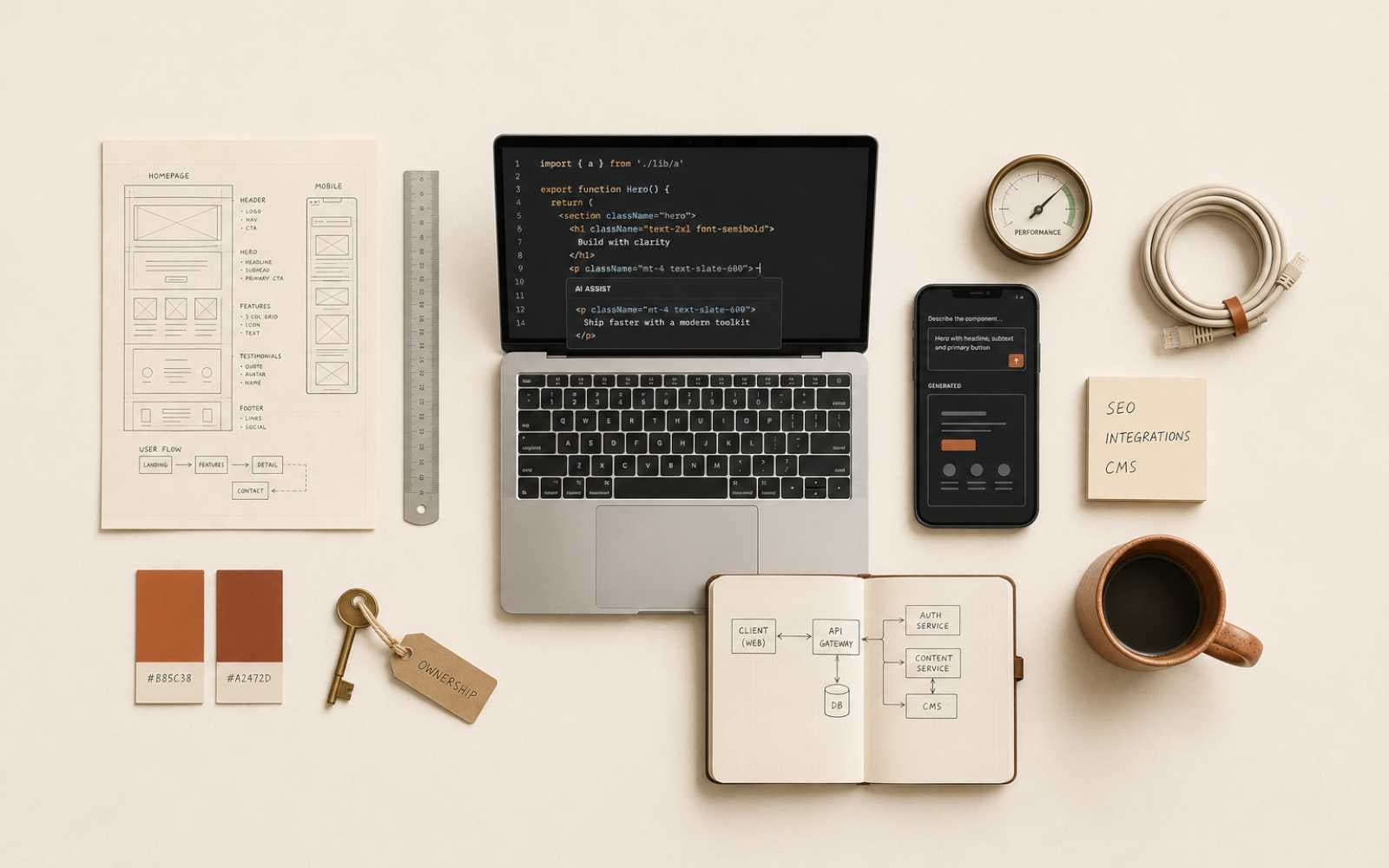
A custom website is worth paying for when you need performance, integrations, security, CMS flexibility, brand differentiation, and technical control. For simple projects, an AI website builder may be enough.
In 2026, paying for a custom website can still make sense, but not in every case. If you only need a simple landing page, a basic portfolio, or an early commercial validation, an AI-powered website builder can be a smart choice. Custom development starts to make sense when your website needs to support sales, generate qualified leads, connect with other systems, load fast on mobile, manage dynamic content, protect data, or represent a brand identity that cannot be properly handled through a generic template.
AI is already part of modern development. According to Stack Overflow's 2025 Developer Survey, 84% of respondents use or plan to use AI tools in their development process, and 51% of professional developers use them daily. The point is not to reject AI, but to understand where it accelerates the process and where technical judgment is still required.
Key Takeaways
- End-to-end AI website builders are useful for prototypes, simple landing pages, initial content, and fast validation. Professional development also uses AI, but with technical judgment over architecture, integrations, and outcome.
- A custom website makes sense when you need performance, integrations, CMS flexibility, security, scalability, or a more specific brand experience.
- The problem is not using AI. The problem is delegating important decisions to a tool without review or technical responsibility.
- The real cost of a website is not just building it. It also includes maintaining, scaling, fixing, and adapting it as the business evolves.
- For businesses in Latin America, mobile experience, trust, and commercial clarity have a direct impact on conversion.
The Right Question Is Not "AI or Developer?"
The question "is it worth paying for a custom website if AI website builders already exist?" is understandable, but incomplete.
A more useful question is this: which parts of the project can an AI tool accelerate, and which parts require technical judgment, architecture, integration, security, performance, and responsibility?
An AI tool can help you generate an initial structure, a visual direction, early copy, interface components, or even a first functional version. That is valuable. It would be unrealistic to deny that these tools are changing how digital products are built.
In 2025, Gartner projected that by 2028, 90% of enterprise software engineers will use AI code assistants, up from less than 14% in early 2024. The firm also noted that the developer role is increasingly moving from pure implementation toward orchestration, system design, problem-solving, and quality supervision.
That is the key: AI reduces friction, but it does not remove the need for good decisions.
It is worth clarifying something many comparisons skip: modern custom development also uses AI. Professional teams use code assistants, UI generators, research models, review tools, and automations at different stages. The real distinction, then, is not "AI or developer." It is end-to-end builders that close the whole process with AI, versus professional development that integrates AI inside a technical process with judgment, review, and responsibility for the result.
In a professional website, many of the important decisions are not "what color should the button be?" or "how do I generate a visually appealing section?" They are questions like:
- How should the content be structured for SEO and AI search engines?
- What data does the form need to capture?
- Where is that data stored?
- What happens if the site grows?
- Who maintains the code?
- How easy will it be to update content?
- What happens if an integration fails?
- How fast does the site load on mobile?
- Which parts of the system actually belong to the client?
That is where a custom website can make sense.
What AI Website Builders Can Do Well
AI website builders are especially useful when the problem is limited, visual, or exploratory.
They help turn an abstract idea into something visible. They can generate an initial structure, explore copy, create design variations, assemble a first landing page, or prototype an interface before making a larger investment.
That matters. For many people, the main barrier is not having "the best possible website" on day one. It is getting started.
A Simple Landing Page
If you have a clear offer, a defined audience, and only need to explain a service, show benefits, and receive inquiries, a builder can cover a lot.
Example: an independent consultant who wants to validate demand for a new service can start with an AI-generated landing page, a simple form, and a small campaign.
A Basic Portfolio
A photographer, designer, coach, or independent professional may only need something simple: who they are, what they do, selected work, testimonials, and a contact form.
In that case, paying for a complex custom solution from day one may be unnecessary.
Early Commercial Validation
If you still do not know whether the product will sell, it often makes sense to validate before investing more.
Example: a small coffee brand testing a preorder campaign can start with Shopify, Tiendanube, Wix, or a landing page connected to a form. If real traction appears later, then it makes more sense to improve infrastructure, brand, content, and experience.
A Visual Prototype
Tools like v0, Figma Make, and AI-powered builders are useful for exploring interfaces. They can turn an idea into something that can be reviewed, discussed, and improved.
Reuters reported that Vercel raised USD 300 million in 2025, reaching a valuation of USD 9.3 billion. The same report noted that v0 had more than 3.5 million users. That shows the market is not treating these tools as toys. They are becoming part of the real digital workflow.
Where AI Website Builders Start to Show Their Limits
The limit does not appear only when a tool generates something visually weak. Many times, it can generate something that looks quite good.
The limit appears when the website stops being an isolated piece and starts becoming part of the business operation.
A website can look good and still not be planned to support a business. That happens when any tool — AI-based or not — is used to solve more than it was designed for.
It can load slowly. It can have weak architecture. It may not be ready for SEO. It may depend too heavily on a closed platform. It may not integrate well with a CRM, booking system, payment processor, email marketing platform, or internal tools. It may not handle user data properly. It may be hard to migrate. It may become technical debt before the business finishes growing.
That is the point many superficial comparisons miss: a demo is not the same as a system.
A demo can impress. A system has to survive real use.
In a professional website, that means the site needs to work when:
- a user visits from a slow phone;
- a campaign starts sending traffic;
- the form receives real leads;
- the client needs to change content without breaking the design;
- Google crawls the page;
- an AI search engine tries to understand what the company does;
- a CRM is connected;
- a blog is added;
- conversion needs to be measured;
- the business needs to iterate without rebuilding everything from scratch.
At that point, the conversation stops being "how fast can I create a website?" and becomes "how well can this website support the business?"
When It Is Worth Paying for a Custom Website
A custom website is not worth paying for simply because it is custom. That is a weak defense of custom development.
It is worth it when there is a concrete reason.
When Your Website Generates Leads or Sales
If your website is a secondary business card, you can keep it simple. But if your website participates in sales, patient acquisition, legal inquiries, bookings, quotes, or commercial requests, technical and strategic quality matters more.
A website that loads slowly, communicates poorly, or fails to build trust can lose opportunities without you noticing.
This is especially important in Latin America. Reuters reported in January 2026 that regional e-commerce is projected to reach USD 215.31 billion in 2026. The same report indicated that 84% of purchases are made through smartphones, that nearly half of users would abandon a platform after a poor experience, and that Argentina, Brazil, and Mexico accounted for almost 85% of regional sales in 2025.
Although that data comes from e-commerce, the lesson applies to many service businesses: in Latin America, mobile experience and digital trust are not secondary details.
When You Need Integrations
An isolated landing page is one thing. A website connected to real business processes is another.
Common integrations include:
- forms connected to a CRM;
- online bookings;
- payments;
- internal dashboards;
- email marketing;
- databases;
- user authentication;
- custom CMS;
- automations;
- dynamic catalogs;
- appointment systems;
- protected content.
The more integrations there are, the more important it becomes to design the architecture properly.
When You Need Control Over Performance
Speed is not a technical luxury. It affects experience, conversion, SEO, and perceived quality.
A well-built custom site can optimize loading, images, page structure, rendering, accessibility, and mobile experience. But this does not happen automatically just because a modern technology is used.
A poor Next.js implementation can be worse than a simple website built well. If you are comparing exactly those two worlds, our analysis of WordPress vs Next.js in 2026 may also help.
The framework is not the guarantee. The implementation judgment is the guarantee.
When Your Brand Needs to Stand Out
Builders have improved a lot. But if your brand competes on trust, premium perception, or strategic clarity, a template can become limiting.
That does not mean every brand needs experimental design. It means the website should feel coherent with the business, not like another variation of a generic template.
For a clinic, consulting firm, law office, real estate agency, or validated product brand, the website does more than inform. It also communicates seriousness, focus, and professional level.
When You Need Ownership and Flexibility
One of the least discussed points is technical ownership.
On a closed platform, you can have a functional website, but many decisions remain conditioned by the ecosystem: customization limits, app costs, data structure, export options, performance, provider rules, or editor capabilities.
A custom website can give you more control over code, infrastructure, data, CMS, integrations, and future evolution.
You do not always need that control. But when you do, it is better to have it from the start.
AI Website Builder vs Custom Website: Practical Comparison
| Criteria | AI website builder | Custom website |
|---|---|---|
| Initial cost | Lower | Higher |
| Launch speed | Very fast | Depends on scope |
| Design | Good for standard cases | More flexible and specific |
| Initial content | Can generate it quickly | Can be integrated into a more careful strategy |
| Performance | Depends on the platform | Can be optimized technically |
| Technical SEO | Limited by the builder | More control over structure, metadata, schema, and performance |
| Integrations | Good if they are standard | Better for specific workflows |
| CMS | General-purpose | Adapted to the business |
| Scalability | Enough for simple cases | Better for growth and iteration |
| Ownership | Partial, tied to the platform | More control over code, data, and infrastructure |
| Best use case | Validation, simple landing page, portfolio, visual MVP | Real operations, strong brand, integrations, or growth |
The honest comparison is not "builders are bad, custom is good." That would be false.
The correct comparison is: each option has an ideal use case.
An AI website builder can be the smart decision when you are starting. A custom website can be the smart decision when the website already has commercial or operational impact.
The Common Mistake: Comparing Only the Initial Price
Many companies compare a custom website against an AI website builder using only one variable: initial cost.
That leads to bad decisions.
Initial cost matters, but it is not everything. You should also consider:
- how much time it will take to adapt the website;
- how easy it will be to maintain;
- how much it limits your growth;
- how much it costs to add new features;
- what happens if you need to migrate;
- how well it converts;
- how fast it loads;
- how clearly it communicates your message;
- how prepared it is for SEO and AI search;
- who responds if something breaks.
A cheap website that you later need to rebuild can become expensive. A custom website that is too large for an unvalidated idea can also be a bad investment.
The decision should not be based on defending a technology. It should be based on identifying the real stage of the business.
What Makes Sense Depending on Your Business Stage
1. Idea or Early Validation
If you are still testing an offer, do not have a clear audience, or do not know whether the product will sell, start simple.
An AI tool, a fast landing page, or a closed platform can give you enough speed to learn.
At this stage, spending too much on architecture can be premature.
2. Operating Business
If you already have clients, validated messaging, clear services, and need to improve perception, acquisition, or trust, a more carefully built professional website starts to make sense.
You do not necessarily need a complex platform. But you do need better structure, better content, better performance, and a more coherent experience.
This is where the middle ground often appears: a well-scoped professional website, with modern technology, a solid SEO base, custom design, and clear scope.
3. Serious Digital Operation
If your website is part of sales, internal processes, dynamic content, automations, integrations, or consistent acquisition, custom development becomes much more reasonable.
At this stage, paying only for "a page" is a narrow way to look at the problem. You are paying for a piece of digital infrastructure.
How to Use AI Without Losing Technical Responsibility
The healthiest position toward AI is neither fear nor blind enthusiasm.
AI can accelerate research, prototyping, variation generation, documentation, testing, visual exploration, and parts of development. It can also reduce time spent on repetitive or mechanical tasks.
But accelerating is not the same as delegating responsibility.
Gartner frames it from a similar perspective: teams will need to balance automation with human supervision, considering business criticality, risk, and workflow complexity.
In a professional website, someone still has to decide:
- which architecture makes sense;
- what should not be built;
- what should be simplified;
- what risks exist;
- which content best answers the user;
- which platform makes sense;
- which integrations are necessary;
- what technical debt is being created;
- which parts should be editable by the client;
- which solution will still be maintainable in six months.
AI can help a lot in the process. But responsibility for the result should not fall on a tool.
That is the central point: it is not about whether a website "uses AI" or not. It is about whether it is well planned, well built, and properly adapted to the business.
Concrete Examples
Independent Psychologist
A psychologist who is just starting to offer online sessions can begin with a simple landing page built with a website builder. They need to explain their approach, show availability, publish contact information, and receive inquiries.
In that case, a custom website can wait.
But if they later start publishing content, attracting patients through SEO, managing appointments, segmenting services, and building professional authority, a more personalized structure may be better.
Law Firm for Small and Medium-Sized Businesses
A law firm advising companies needs to build trust, explain complex services, publish articles, receive qualified inquiries, and possibly connect forms to a CRM.
Here, content, architecture, and clarity matter a lot. A template may work visually, but fall short in strategy, structure, and scalability.
Product Brand With Recurring Sales
A product brand with real traction needs mobile speed, trust, clear policies, payments, logistics, analytics, and campaign integration.
It can start with Shopify, Tiendanube, or a similar solution. But if the business grows and needs a more differentiated experience, a custom or semi-custom architecture can make sense.
Common Myths
"If a website can be made with AI, I should not pay for development"
Incorrect. The fact that something can be generated quickly does not mean it is ready to operate well. This applies to a website built with a builder just as much as one delivered by a technical team without a real process. Speed is not the problem. Lack of judgment about what to build is.
AI can produce a first version. Professional value appears in deciding what to keep, what to correct, what to simplify, what to scale, and what to avoid.
"A custom website is always better"
No. A poorly planned custom website can be more expensive, slower, and harder to maintain than a well-used builder.
Custom does not automatically mean better. It means more control and more responsibility.
"Builders are only for unserious projects"
Not true. Many modern tools are solid and useful. For certain cases, they are the best decision.
The problem appears when they are used to solve needs that already exceed their ideal use case.
"AI replaces strategy"
No. It can assist strategy, but it does not fully replace it.
A tool can generate copy, sections, and layouts. But it does not understand by itself the real positioning of the business, lead quality, service margins, sales process, or operational priorities.
"You either use AI or you work with a developer, not both"
False, and probably the most common misunderstanding. Modern professional development uses AI in the workflow: research, prototyping, variation generation, parts of the code, documentation, and testing. What distinguishes professional development is not rejecting AI. It is not delegating to it the technical responsibility for the result.
FAQ
Can an AI-built website rank on Google?
Yes, it can rank if it has good content, clear structure, acceptable performance, proper indexation, and enough authority. The problem is not that it was assisted by AI. The problem is publishing generic, inaccurate, or poorly structured content.
Is a custom website always better than Wix, Squarespace, or Shopify?
No. For a simple landing page, portfolio, or early validation, a builder may be more convenient. A custom website makes more sense when you need control, integrations, performance, scalability, or a more specific brand experience.
When should I start with an AI website builder?
It makes sense when the scope is simple, the budget is limited, you need to launch quickly, or you are still validating the offer. It can also help prototype ideas before investing in a more developed solution.
What if I already have an AI-built website and want to improve it?
You can audit it. Review speed, SEO structure, messaging clarity, mobile experience, forms, analytics, accessibility, content, conversions, and integrations. Sometimes improving the existing website is enough. Other times, rebuilding specific parts makes more sense.
Is Next.js better than WordPress or an AI website builder?
It depends. Next.js can be an excellent option for fast, personalized, and scalable websites, especially when there are specific technical needs. But WordPress or a builder can be enough for simple websites. The right technology depends on scope, not on an abstract preference.
How much should I invest in a professional website in 2026?
It depends on the impact the website has on your business. If you only need basic presence, overbuilding does not make sense. If the website participates in sales, reputation, acquisition, or internal processes, it is better to think of it as digital infrastructure, not as a visual expense.
Conclusion
Paying for a custom website in 2026 can be worth it, but only when there is a concrete reason.
AI tools are useful, fast, and increasingly capable. For many simple projects, they can be the right path. The mistake would be dismissing them out of technical prejudice.
But it would also be a mistake to assume that a quickly generated website is ready to support a business. When sales, leads, integrations, dynamic content, performance, SEO, security, brand, and growth are involved, the value is no longer just "making a page." It is building a digital foundation that works, can be maintained, and makes sense for the real stage of the business.
If you are evaluating whether you need a custom website or whether a simpler tool is enough, the first step should not be choosing a technology. It should be understanding what your website needs to achieve and how important it is to your operation.
At Senda Lógica, we work from that question: not every business needs the same solution, and a good technical decision starts by recognizing the real stage of the business.
Sources Consulted
- Stack Overflow Developer Survey 2025 — adoption of AI tools in development. (survey.stackoverflow.co)
- Gartner — 2025 strategic trends in software engineering and adoption of AI code assistants. (gartner.com)
- Vercel — Series F: amount raised and valuation. (vercel.com)
- Reuters — Coverage of Vercel's Series F, the source of the v0 user count: Vercel's own announcement does not publish it. (tech.yahoo.com)
- Reuters — Latin American e-commerce projection, mobile commerce, and user experience. (finance.yahoo.com)
Table of contents
- Key Takeaways
- The Right Question Is Not "AI or Developer?"
- What AI Website Builders Can Do Well
- A Simple Landing Page
- A Basic Portfolio
- Early Commercial Validation
- A Visual Prototype
- Where AI Website Builders Start to Show Their Limits
- When It Is Worth Paying for a Custom Website
- When Your Website Generates Leads or Sales
- When You Need Integrations
- When You Need Control Over Performance
- When Your Brand Needs to Stand Out
- When You Need Ownership and Flexibility
- AI Website Builder vs Custom Website: Practical Comparison
- The Common Mistake: Comparing Only the Initial Price
- What Makes Sense Depending on Your Business Stage
- 1. Idea or Early Validation
- 2. Operating Business
- 3. Serious Digital Operation
- How to Use AI Without Losing Technical Responsibility
- Concrete Examples
- Independent Psychologist
- Law Firm for Small and Medium-Sized Businesses
- Product Brand With Recurring Sales
- Common Myths
- "If a website can be made with AI, I should not pay for development"
- "A custom website is always better"
- "Builders are only for unserious projects"
- "AI replaces strategy"
- "You either use AI or you work with a developer, not both"
- FAQ
- Can an AI-built website rank on Google?
- Is a custom website always better than Wix, Squarespace, or Shopify?
- When should I start with an AI website builder?
- What if I already have an AI-built website and want to improve it?
- Is Next.js better than WordPress or an AI website builder?
- How much should I invest in a professional website in 2026?
- Conclusion
- Sources Consulted