Digital Strategy
Social Media or a Website? What Each Type of Business Actually Needs in 2026
Compare social media, business websites, and Google Business Profile to choose the right digital presence for your industry, customers, and growth stage.
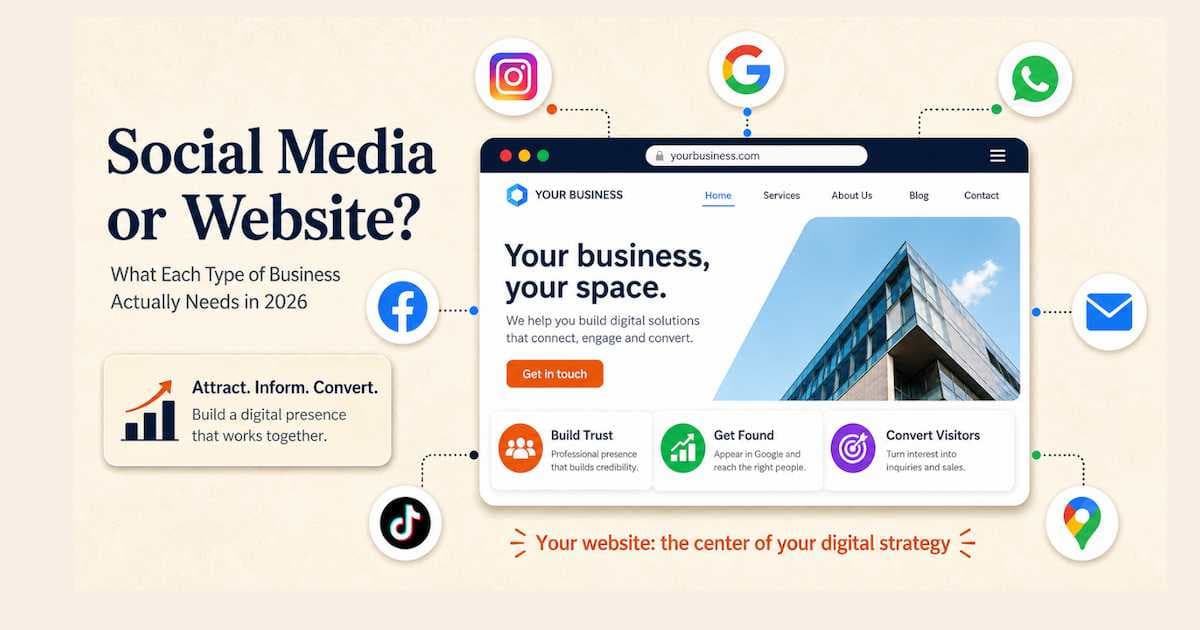
A business website and a social media profile do not solve the same problem. Social platforms are effective for discovery, conversation, and frequent content distribution. A website organizes information, builds trust, captures search demand, and gives the business control over the customer experience. For most companies, the right decision is not to choose one and abandon the other, but to determine which channel should serve as the primary foundation.
The clearest evidence is that multichannel strategies are already standard practice. A Small Business & Entrepreneurship Council survey published in October 2025 found that 91% of the small businesses surveyed used multiple channels to reach customers. Fifty-four percent used social media, while 53% used their own website. (sbecouncil.org)
The right combination depends on the type of business, the value of the purchase, the level of trust required, and how customers search for a solution.
Quick answer
- Social media is better for attracting attention, showing activity, and interacting with an audience.
- A website is more useful for search visibility, credibility, permanent information, automation, and conversion.
- A visual, impulse-driven business may start with Instagram, while a professional services or B2B company usually needs an owned website earlier.
- Local businesses should also consider Google Business Profile, Maps, and customer reviews.
- Relying entirely on a third-party platform leaves the audience, reach, and rules outside the company's control.
1. Why a website and social media serve different purposes
Social media distributes content inside someone else's platform. A website acts as the central source of information for the business.
Instagram, TikTok, Facebook, and LinkedIn already have users, recommendation systems, messaging tools, and established content formats. A company can create an account quickly, publish photos or videos, and begin interacting with potential customers without developing its own infrastructure.
That accessibility explains their commercial value. In Verizon's May 2025 State of Small Business Survey, 76% of small and medium-sized businesses said social media had a positive impact on their performance. (verizon.com)
The limitation is that the business does not control the platform. An algorithm update can reduce organic reach. An account restriction can interrupt communication. Important information can become buried under months of posts and temporary stories.
In a discussion on r/webdev, one user described a common frustration: restaurant social profiles often make it difficult to find basic information such as a complete menu, opening hours, or other permanent details. (reddit.com)
A business website serves the opposite function. It does not provide an existing audience, but it allows the company to decide which information appears first, how the offer is explained, and what action the visitor should take. It can also integrate forms, bookings, payments, catalogs, calendars, and internal systems.
Joe Pulizzi, founder of the Content Marketing Institute, uses the metaphor of "rented land" to describe third-party platforms. His argument is not that businesses should abandon them, but that they should avoid building critical assets entirely on platforms they do not own. (contentmarketinginstitute.com)
Social media is usually best used for attention and distribution. The website should function as the permanent commercial foundation.
2. How to decide based on the way customers buy
The decision should be based on the customer journey, not on which channel appears newer or more popular.
Four variables help determine what a business actually needs.
Purchase value and perceived risk
The more expensive or sensitive a decision is, the more information the customer will require. Hiring a lawyer, medical clinic, consultant, or construction company requires more validation than ordering a cake or booking a makeup appointment.
Qualtrics analyzed more than 23,000 responses across 23 markets for its 2025 consumer trends report. Trust emerged as the leading priority when customers interacted with a company. Consumers were also 1.7 times more likely to purchase more from brands they trusted. (qualtrics.com)
Search intent
Someone who discovers a product while browsing Instagram may not yet intend to buy. Someone searching for "accountant for exporters," "dermatologist near me," or "property management software" is already trying to solve a specific problem.
Offer complexity
A simple product can often be explained in one post. A service involving several phases, conditions, use cases, or plans needs a more structured format.
Information lifespan
Promotions, events, and current updates work well on social media. Service descriptions, pricing guidance, processes, policies, case studies, and frequently asked questions should live somewhere permanent.
The basic decision framework looks like this:
| Business situation | Channel that should take priority |
|---|---|
| Visual, low-cost, impulse-driven product | Social media |
| High-trust professional service | Owned website |
| Local business with in-person service | Google Business Profile + basic website |
| B2B or industrial company | Corporate website + LinkedIn |
| Store with frequent orders | Owned e-commerce platform |
| Content-driven personal brand | Social media + owned website or newsletter |
The right question is not where publishing is easier. It is where the customer can best complete the decision-making process.
3. Which channel works best for each type of business
Different sectors receive different levels of value from websites and social platforms.
Visual products and image-based services
Bakeries, fashion brands, decorators, photographers, restaurants, and beauty professionals benefit heavily from Instagram and TikTok. The result can be demonstrated immediately through photos, videos, behind-the-scenes content, and testimonials.
In Argentina, Instagram's estimated advertising reach was 31.1 million users at the end of 2025, equivalent to 74.7% of the country's internet users. These figures represent potential advertising reach, not confirmed monthly active users, but they demonstrate the size of the platform. (datareportal.com)
For these businesses, a website becomes more valuable when they need to organize a catalog, accept orders, or stop answering the same questions repeatedly through direct messages.
Professionals and service companies
Lawyers, doctors, architects, consultants, real estate agencies, and accounting firms depend more heavily on trust and active search behavior. A social account can demonstrate expertise, but a website allows the business to present credentials, specializations, locations, processes, and contact methods without forcing the potential client to reconstruct that information from scattered posts.
B2B and industrial companies
For B2B businesses, the website should usually be the foundation. Logistics, technology, energy, manufacturing, and corporate service companies need to explain capabilities, industries served, processes, certifications, and previous work.
LinkedIn can distribute those materials and support professional credibility, but it should not be the only place where the information exists.
E-commerce
Selling through messages may be enough during early validation. As order volume increases, problems appear around inventory, payments, tracking, and customer support. Platforms such as Shopify, Tiendanube, and WooCommerce exist to move those tasks away from manual conversations and into an organized purchasing flow.
The priority should depend on the job each channel must perform, not only on the business category.
4. When social media may be enough
Operating mainly through social media can be a reasonable decision when the business is still small, simple, and relationship-driven.
Not every company needs to begin with a fully custom website. Social media may be sufficient temporarily when:
- The offer is still being validated.
- The product catalog is small.
- Most customers arrive through referrals.
- The sale requires a personal conversation.
- The volume of inquiries remains manageable.
- The business operates only during events, fairs, or specific seasons.
- The owner can keep the profile consistently updated.
A custom dessert business, for example, may use Instagram to show previous work, WhatsApp to receive inquiries, and manual communication to close orders. Investing immediately in a complex platform would probably not solve its main problem, which is generating consistent demand.
On Reddit, small business owners frame the question in practical terms. They ask whether a website actually helps them sell, organize information, or appear more professional. That framing is more useful than asking whether every business must have a website. (reddit.com)
The limitation appears when the channel creates too much repetitive work. If every customer needs to ask about prices, availability, opening hours, location, and conditions, the apparently simple setup begins to produce operational costs.
An abandoned profile is also a liability. A social account with outdated information can damage trust more than a small, stable website. A minimal online presence must still be maintained correctly. Opening five profiles without the ability to keep them current is not a multichannel strategy.
Social media is enough when it simplifies operations. When it begins to complicate them, the business needs a more structured foundation.
5. Signs that your business already needs a website
A website is justified when it can reduce commercial friction, answer objections, or capture opportunities that are currently being lost.
These are the clearest indicators.
1. You repeat the same information constantly
Prices, services, processes, requirements, and frequently asked questions should be accessible without requiring a conversation.
2. Customers research before contacting you
This is especially common in healthcare, legal services, consulting, construction, real estate, and B2B services.
3. Your projects have a high value
An expensive decision requires stronger credibility signals: a professional domain, case studies, information about the team, a clear process, and transparent conditions.
4. You need to appear in Google searches
Social posts may appear in search engines, but they offer less control over which queries each piece of content addresses.
5. You need to measure conversions
A website makes it possible to distinguish between visits, completed forms, phone calls, reservations, downloads, and acquisition sources.
6. You need to automate part of the service
Bookings, payments, preliminary quotes, document uploads, and catalogs can reduce manual administrative work.
Clutch surveyed 406 small business owners in August 2025. Eighty-three percent had a website. Among those with websites, 40% identified SEO as their main source of business leads. Only 10% of all respondents considered social media their primary source. (clutch.co)
That study reflects the United States and should not be applied mechanically to every Latin American market. It still illustrates an important distinction: social media can generate attention, while a search-oriented website can capture existing demand.
6. Google, reviews, and local search: the third component
For a local business, choosing only between Instagram and a website ignores one of the most important channels: Google Business Profile.
When someone searches for a nearby clinic, restaurant, real estate agency, or repair shop, they usually need the address, opening hours, photographs, reviews, and an immediate contact option. Google Business Profile allows companies to manage that information in Google Search and Maps at no cost. (business.google.com)
A local business can therefore build an effective digital presence with three layers:
- Google Business Profile: local discovery, location details, and reputation.
- Website: complete information, services, and conversion.
- Social media: current updates, visual proof, and community interaction.
BrightLocal's 2025 Local Consumer Review Survey found that 92% of respondents considered photos and keyword filters useful when reading reviews. Customers are not only looking at star ratings. They want specific evidence about products, service quality, facilities, and results. (brightlocal.com)
A hair salon, for example, can use Instagram to show recent work, Google Maps to capture nearby searches, and a basic website to explain services, approximate prices, and booking options.
A restaurant can publish daily updates on social media, but its menu, address, and opening hours should remain available in channels that customers can search and consult quickly.
Karen Kerrigan, president of the SBE Council, describes multichannel strategy as a way for businesses to meet customers where they are. The important clarification is that being present across several channels does not mean duplicating the same content everywhere. Each channel should perform a distinct function. (sbecouncil.org)
7. How a website affects SEO and AI search visibility
An owned website allows a business to publish stable, structured, and crawlable information that may appear in both Google Search and generative search experiences.
For a page to appear as a supporting link in Google AI Overviews or AI Mode, Google states that it must be indexed, eligible to appear in traditional search results, and permitted to display a text snippet. There is no special markup that guarantees inclusion in generative results. (developers.google.com)
This corrects a common misunderstanding about Generative Engine Optimization. There is no technical shortcut that forces ChatGPT, Gemini, Perplexity, or Google to cite a company.
The foundation remains useful, verifiable, and accessible information.
A service website can improve its discovery potential by including:
- A dedicated page for each service.
- Direct answers to real customer questions.
- Case studies with context and verifiable outcomes.
- Clear information about location, coverage, and specialization.
- Author names, publication dates, and cited sources.
- Semantic HTML and understandable internal links.
- Structured data that matches the visible content.
Google states that the core practices of SEO remain relevant to its AI features: useful content, permitted crawling, a good page experience, visible text, and structured data that accurately represents the page. (developers.google.com)
Social platforms still matter because they generate mentions, discussions, and brand recognition. A social post, however, does not replace a canonical source where a business can provide a complete answer and keep it updated.
For a small business, GEO should not become a separate project from SEO. It should be treated as an extension of a strong editorial and technical foundation.
8. The minimum digital presence for each business stage
Investment should increase as the commercial complexity of the business increases.
| Business stage | Recommended presence | Primary objective |
|---|---|---|
| Initial validation | One main social platform + WhatsApp + Google listing when relevant | Confirm market demand |
| Operating business | Owned domain + basic website + primary social channel | Centralize information and establish trust |
| Growth stage | Service pages, analytics, local SEO, and automation | Capture and process more opportunities |
| Expansion stage | Specialized content, integrations, campaigns, and conversion optimization | Build a scalable commercial system |
A minimum viable website does not need ten sections or advanced functionality.
For a service professional, it may include a homepage, services, profile or team information, relevant case studies, frequently asked questions, and a contact page.
A local business should also include its address, opening hours, and booking options.
A B2B company needs information about capabilities, industries served, and evidence of previous projects.
Execution quality matters more than the number of pages. A slow, generic, or outdated website does not create trust simply because it exists.
Custom development is also not automatically superior to WordPress, Webflow, Shopify, or Tiendanube. The technology should be selected according to the content, integrations, maintenance requirements, and business objectives.
Results should be measured through qualified inquiries, bookings, sales, quote requests, and administrative time saved. Followers, impressions, and visits are secondary indicators unless they lead to a commercial action.
The SBE Council survey also found that 30% of the businesses using multiple channels had added a new channel during the previous year. Digital presence is not a permanent decision. It should evolve as the business changes. (sbecouncil.org)
FAQ
Can a business operate only through Instagram?
Yes, particularly during the validation stage or when it sells visual products through direct conversations. The limitation appears when information becomes difficult to find, message volume increases, or customers need to research before buying. Instagram can remain the main discovery channel, while a simple website handles permanent and repetitive information.
What should I create first: a website or social media profiles?
It depends on how customers find the business. A professional, consultant, or B2B supplier should usually prioritize a clear website and a LinkedIn presence. A fashion, beauty, or food business may begin with Instagram and Google Business Profile. The right priority is the channel that demonstrates the offer and supports the customer's next step.
Does a website automatically generate customers?
No. A website needs a traffic source, such as SEO, Google Business Profile, advertising, social media, referrals, or email campaigns. Its role is to receive that attention and convert it through clear information, credibility, and calls to action. Web development is one component of the commercial system, not the entire system.
Is a custom website better than WordPress or a website builder?
Not universally. A custom solution can provide greater control, performance, and integration, but there must be a specific need that justifies it. WordPress, Webflow, Shopify, or Tiendanube may be appropriate for standardized projects. The decision should consider scope, maintenance, budget, data ownership, integrations, and expected growth.
Do I need to publish constantly on every social platform?
No. Maintaining one or two relevant channels is better than opening several abandoned profiles. Choose the platform where your audience actually discovers or evaluates services, and give that platform a clear commercial role. An industrial company may focus on LinkedIn, while an architecture studio may combine Instagram and LinkedIn.
Can a website help a business appear in AI-generated answers?
It can help because it allows the company to publish detailed, attributable, and indexable content, but it does not guarantee a citation. Google states that there are no special requirements for appearing in its generative results beyond the fundamentals of SEO. The strongest foundation is original, accessible, current, well-structured, and verifiable content. (developers.google.com)
Choose a foundation instead of collecting channels
The strongest digital presence is not the one that uses the largest number of platforms. It is the one that reduces friction between a customer's need and a purchase decision.
Social media can generate attention. Google can capture local intent. An owned website can explain, validate, and convert.
For a small business or professional service provider, the starting point should be identifying which questions the customer needs answered before making contact and which tasks are currently being handled manually. From there, it is possible to define a website with a precise scope, without unnecessary features or vague promises.
Senda Lógica develops custom websites for professionals and service companies that need a clear, fast, and scalable online presence. An initial assessment can determine whether a business requires a complete custom build, a smaller website, or simply a better organization of the channels it already uses.
Sources
- Small Business & Entrepreneurship Council — Small Business Check Up and Tech Use Survey, October 2025 https://sbecouncil.org/2025/10/23/new-sbe-council-survey-small-businesses-confident-about-2025-year-end-performance-ai-digital-tools-and-multi-channel-strategies-driving-growth-and-competitiveness/
- Verizon — 2025 State of Small Business Survey https://www.verizon.com/about/news/2025-state-small-business-survey
- Clutch — The State of Small Business Websites in 2025 https://clutch.co/resources/state-of-small-business-websites-2025
- Qualtrics — Special Report: Building Consumer Trust https://www.qualtrics.com/ebooks-guides/building-consumer-trust/
- DataReportal — Digital 2026: Argentina https://datareportal.com/reports/digital-2026-argentina
- BrightLocal — Local Consumer Review Survey 2025 https://www.brightlocal.com/research/local-consumer-review-survey-2025/
- Google Search Central — AI Features and Your Website https://developers.google.com/search/docs/appearance/ai-features
- Google Search Central — Optimizing Your Website for Generative AI Features https://developers.google.com/search/docs/fundamentals/ai-optimization-guide
- Google Business Profile https://business.google.com/en-all/business-profile/
- Content Marketing Institute — Yet Another Reason Not to Build Your Content Home on Rented Land https://contentmarketinginstitute.com/content-creation-distribution/yet-another-reason-not-to-build-your-content-home-on-rented-land
- Reddit, r/webdev — Instagram Page Better Than a Real Website? https://www.reddit.com/r/webdev/comments/178l0yb/instagram_page_better_than_a_real_website_for/
- Reddit, r/AskArgentina — Did having a website help your business, or is Instagram enough? https://www.reddit.com/r/AskArgentina/comments/1redy96/les_sirvi%C3%B3_tener_p%C3%A1gina_web_para_su/
Table of contents
- 1. Why a website and social media serve different purposes
- 2. How to decide based on the way customers buy
- Purchase value and perceived risk
- Search intent
- Offer complexity
- Information lifespan
- 3. Which channel works best for each type of business
- Visual products and image-based services
- Professionals and service companies
- B2B and industrial companies
- E-commerce
- 4. When social media may be enough
- 5. Signs that your business already needs a website
- 1. You repeat the same information constantly
- 2. Customers research before contacting you
- 3. Your projects have a high value
- 4. You need to appear in Google searches
- 5. You need to measure conversions
- 6. You need to automate part of the service
- 6. Google, reviews, and local search: the third component
- 7. How a website affects SEO and AI search visibility
- 8. The minimum digital presence for each business stage
- FAQ
- Can a business operate only through Instagram?
- What should I create first: a website or social media profiles?
- Does a website automatically generate customers?
- Is a custom website better than WordPress or a website builder?
- Do I need to publish constantly on every social platform?
- Can a website help a business appear in AI-generated answers?
- Choose a foundation instead of collecting channels
- Sources